
Multicolor Bulb Using Arduino Project


Since now we are all familiar with RGB LED’s let us show you one of the products made by us ( Karkhana Makerspace).
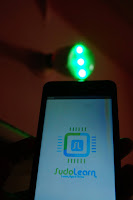

The below is the video of our product (Mobile Control RGB Bulb)

Working description:

It is a decoration lamp which can be used to lighten your home according to your mood or occasion.
The color selection of the lamp is simply controlled with the help of our app.
The concept is the same as I have mentioned in my previous blogs here we are giving instructions wireless via Bluetooth to the controller which drives the lamp.

For any detail or query regarding the above project,
Contact us at hello@karkhana.club

Thinking?
Join our hands-on training courses.
To know more visit us at https://karkhana.club/

Comments

Popular posts from this blog

IoT Based LPG Gas Monitoring

MQ-5 Module(Overview ) In this tutorial, will learn, how to interface MQ-5 Module with Node Mcu(ESP8266). The Grove - Gas Sensor(MQ5) module is useful for gas leakage detection (in home and industry). It is suitable for detecting H2, LPG, CH4, CO, Alcohol. Due to its high sensitivity and fast response time, measurements can be taken as soon as possible. The sensitivity of the sensor can be adjusted by using the potentiometer. MQ-5 Module(backside) Components Required NodeMcu(ESP8266)  MQ-5 LPG SENSOR Module  Few male to female connecting wires  Breadboard  Follow the image below for circuit connection reference:- In this circuit, we have connected the A0 pin of the MQ-5 to the A0 pin of the NodeMcu module and D0 pin remain disconnected. After making the circuit dump the code given below:- // Karkhana Report // Analyse the volume of the gas using thingspeak.com // Hardware: NodeMCU,MQ-5 #include <ESP8266WiFi.h> String apiKey = "Ent...

Servo Motor Interfacing with Arduino

In this tutorial, we will learn how to interface a servo motor using Arduino UNO. The motor inside the setup of a servo is attached by gears to the control wheel. When the motor rotates, the potentiometer’s resistance changes hence the control circuit can precisely regulate how much movement there is and in which direction. The motor’s speed is proportional to the difference between its actual position and desired position. When the shaft is near the desired position it turns slowly else fast. This is called proportional control. They are controlled by sending PWM (pulse width modulated) signals through the control wire. They are available in many sizes and are of three types Positional rotation  Continuous rotation  Linear The most common type is the positional rotational one. So now we are familiar with the motor let us interface it Components Required: Servo motor 1No Arduino UNO 1No Few connecting wires Breadboard Follow the video belo...

Interfacing of Push Button With ATmega16

In this tutorial, we will learn how to interface a switch(push button) with ATMEGA16 using AVR studio. In the previous video, we learnt how to interface LEDs with ATMEGA16 using AVR studio. The push-button is a component that connects two points in a circuit when you press it. The example turns on an LED when you press the button. Here we have connected two push button to PORT C in  PC0 & PC1. And for LEDs connection please refer my previous blog. Components Required:- AVR Controller(Atmega16) LEDs Push Button Connecting Wires USBASP Programmer Dump the following code after connection  and select chip ATMEGA 16. #include<avr/io.h> #include<util/delay.h> void main()  {    DDRB=0b11111111;    int S1;    int S2;      while(1)    {     S1=PINC&0b00000001;     S2=PINC&0b00000010;     if(S1==0b00000001)     { ...